
The Legacy of Studio Anne Carlton
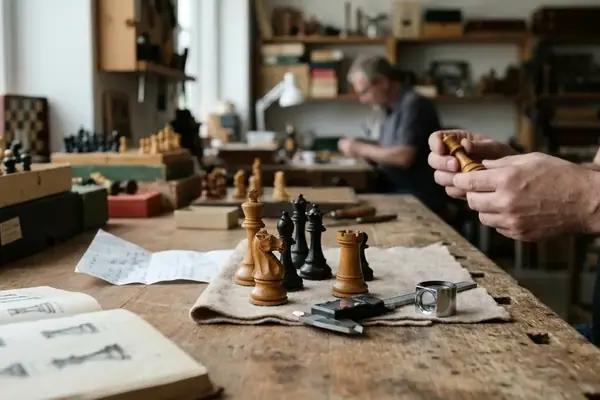
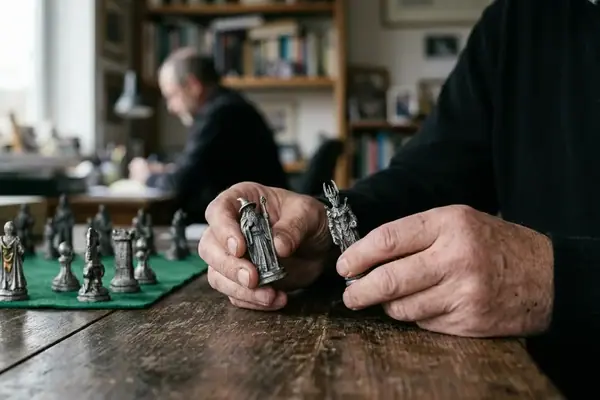
I often start my provenance research by turning a single pawn over in my hands. The weight, the base felt, and the paint application tell a story before I even look at the subject matter. Studio Anne Carlton (SAC) emerged in the late 1960s as a defining force in British themed chess production. Anne Carlton, the founder and original designer, established a studio identity that treated the chessmen not merely as souvenirs, but as a distinct design lineage—a method combining a post-1849 Staunton chess hierarchy with historical and literary subject matter.
The Staunton reference point remains strictly operational. A king, queen, bishop, knight, rook, and pawn must remain distinguishable even when converted into monarchs, soldiers, clergy, towers, or foot troops. This proven approach prevents the board from devolving into a confusing diorama.
Artisan Craftsmanship and Production Methods
Early studio pieces are cast figurative chessmen finished by hand. This represents a sharp departure from machine-cut wooden Staunton pieces. Sculpted masters established the character forms, while cast pieces supplied the repeatable body. Hand finishing supplied the surface detail.
The standard brown-and-ivory finish emphasizes silhouette and side distinction. The premium hand-decorated artisan options add painted clothing, armour, weapons, crowns, shields, and facial accents. Without certified documentation, collectors usually examine packaging, base treatment, leaflets, country-of-origin wording, and paint aging together instead of relying on the subject matter alone.
Expert Tip: History sheets and after-sales care leaflets matter because they document the research premise of the set and give handling guidance for painted surfaces, especially where raised weapons, crowns, or banners are vulnerable to rubbing and knocks.
Historical Accuracy in the Crusades Set
Cross-checking within established frameworks confirmed the historical frame used for the Crusades set spans the 1095-1292 crusading period. The late 12th century proves especially relevant. King Richard I ruled from 1189 to 1199. French monarch King Philip II reigned from 1180 to 1223. This makes both defensible figures for a late-12th-century crusading theme.
The Third Crusade timeframe of 1189-1192 places them in the same broad campaign context, even though their participation and political objectives diverged. The Muslim army features a composite vocabulary across the wider 1095-1292 range, representing Saracens, Seljuks, and Mameluks. Mameluk power becomes especially relevant from the mid-13th century onward.
Cotton, mohair, and taffeta serve as plausible visual cues for medieval Mediterranean exchange. Luxury textiles and textile terms reached western Europe through Arabic, Byzantine, and trade contacts across the 12th and 13th centuries.
Recreating Hastings and Bannockburn
The 1066 English succession set anchors firmly to 14 October 1066. This marks the southern English Battle of Hastings between Harold II's Saxon army and William, Duke of Normandy. Harold II ruled from January 1066 until his death on that battlefield. William became king of England in 1066 and ruled until 1087.
The inclusion of Harold Hardrada requires careful reading. Hardrada died on 25 September 1066 at the northern English battle that preceded the southern engagement. If he appears in the same themed range, he represents the wider 1066 succession crisis rather than the 14 October battlefield itself.
The Scottish independence set anchors to 24 June 1314. This represents the second day and decisive date of the engagement near Stirling.
Manufacturing Shifts and Collector Limitations
The key manufacturing boundary for collectors is around 2004, when production shifted outside the UK. This geographical shift impacts the classification of vintage versus modern sets. I do not treat every branded medieval or battle set as the same collectible class. I distinguish pre-2004 UK-made hand-painted sets from later production.
During my research, pre-2004 examples were typically assessed through combined evidence: original box, insert or label wording, care leaflet, history sheet, base felt, country-of-origin marking, paint application, and wear pattern. While provenance markers reliably date early SAC sets, authentication methods for hand-painted resin remain subjective when original packaging is lost.
Hand-painted pieces show small brush and colour variations between figures. Perfectly uniform decoration can indicate later production, restoration, or repainting and needs closer inspection. A complete set is never guaranteed to retain its historical integrity if missing pawns, broken weapons, or mismatched replacement figures are present. A complete set must have all 32 chessmen with side identity still clear after aging.
Caution: Authentication is strongest when the chessmen, box, paperwork, and finish condition survive together; restored or repainted pieces can erase the most useful production clues.
Final Thoughts on SAC Games
The strongest sets preserve the six chess functions while converting them into recognizable rulers, consorts, clergy, cavalry, strongholds, and infantry. These themes span sharply defined historical anchors: 1066 for the English succession crisis, 1095-1292 for the crusading period, and 1314 for the Scottish independence setting.
Playing with historically grounded, hand-decorated pieces offers distinct cognitive value. Players associate moves with figures, dress, weapons, and political roles rather than with anonymous abstract shapes. This engages deductive logic in a way that purely abstract Number-Line games do not.
The aesthetic value depends on hand decoration retaining enough contrast that the two sides, ranks, and individual characters remain readable under normal tabletop lighting. That balance ensures the set functions as both playable equipment and historical illustration.
Main Point: Later production is not automatically inferior for play value; the distinction matters most for collectors who price provenance, hand-decoration, and pre-2004 manufacturing origin.