Watch an infant during supervised tummy time. Between the newborn stage and around six months, these short floor sessions build the neck and shoulder strength required to hold the head steady and coordinate gaze. This physical milestone precedes any tabletop interaction. Once a child can track a caregiver, turn-taking begins.
Peek-a-boo becomes highly relevant in the four-to-nine-month range. The infant coordinates attention between a face, a covered object, and the return of that person. Simpler expectation responses can appear earlier under controlled observation, but more reliable hidden-object search appears between approximately eight and twelve months.
The operational bridge to strategy is not planning several moves ahead. It is the repeated experience that an unseen person or object still exists and will reappear. This is the foundation of object permanence.
Early Strategy and Sequential Movement
Preschool interventions in the number-board-game literature commonly use brief adult-guided play sessions. Per documented metrics, results show measurable progress after an estimated four sessions of roughly 15 to 20 minutes across a 7-to-14-day classroom window. Early childhood education providers, such as Hoboken Preschool, use structured play for intellectual development during these critical windows.
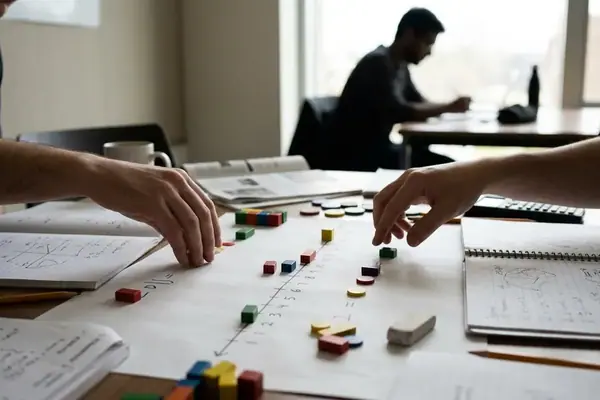
According to available data, the target age band is usually three to five years. Children at this stage are consolidating one-to-one correspondence and stable count order. They are also grasping the idea that later positions on a line represent larger quantities. Number-Line games introduce sequential movement to young learners.
A typical activity uses a linear board with numbered spaces, a single token, and a spinner or die. The adult prompts the child to count each space aloud as the token advances. The educational decision is to make movement left-to-right or start-to-finish. A linear board is not guaranteed to teach math alone, but it maps directly onto numerical magnitude.
Caution: Decorative looping tracks can weaken the mapping between distance traveled and numerical size.
Mapping the Brain: Campitelli and Gobet
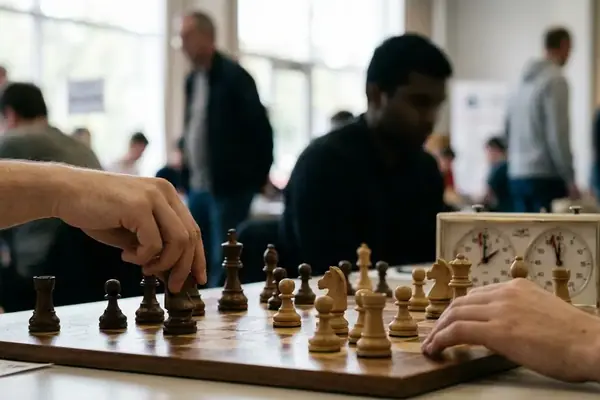
Classic chess-memory protocols expose players to a position for only a few seconds before asking them to reconstruct the board. Experts consistently outperform novices when the position comes from a plausible game. When pieces are randomized so that normal tactical and strategic relations disappear, the expert advantage sharply narrows.
A chess expert's recall advantage can collapse on randomized boards, so chess memory research should not be described as evidence for general photographic memory. The memory gain is tied to meaningful patterns.
Social scientist and chess researcher Fernand Gobet provides foundational theories on how players chunk information. Gobet's chunking and template theory describes stored configurations like castled-king positions, pawn chains, and mating nets as retrievable units rather than isolated squares. Guillermo Campitelli, a researcher focusing on learning disabilities, analyzes how the brain processes these complex game states. Their combined research from the 2000s to the 2010s highlights the intersection of cognitive psychology and traditional tabletop gaming. Later reviews through the early 2020s continue to debate the size and limits of practice effects.
Deductive Logic and Aptitude Testing
Beyond chess, specific board games target distinct cognitive functions and problem-solving skills. The classic game Clue is designed around deductive logic. The hidden solution is fixed at setup by placing one suspect, one weapon, and one room aside. Every shown card eliminates a possibility from the player's private evidence grid.
A strong player records not just confirmed negatives but also who failed to disprove a suggestion. Absence of evidence across multiple turns narrows the solution space.
Expert Tip: In practice, a child may learn to win Clue by copying an adult's notation sheet without understanding deduction; the improvement is then procedural compliance, not independent logical reasoning.
Mastermind operationalizes hypothesis testing through a secret code, a limited number of guesses, and feedback pegs indicating correct color-position matches and correct colors in wrong positions. The game is used beyond recreation, serving as a tool for aptitude testing in programming courses. In introductory programming contexts, based on reported figures, Mastermind is often used during the first one to three weeks of a course or screening exercise. It tests loops, conditionals, arrays, comparison logic, and systematic debugging without requiring a large software system.
The Scope of Transferable Skills
Game-based self-control yields documented academic benefits and enhances communication. Self-control games used in early-childhood classrooms typically require children to wait for a cue, inhibit an automatic response, follow a rule change, or explain a move to a peer. These are the exact executive-function demands later used in classroom routines.
While intellectual development is supported by gameplay, researchers caution against assuming all game skills transfer universally. Chess-instruction and game-based-learning reviews from the mid-2010s through the early 2020s repeatedly distinguish near transfer from far transfer. Near transfer includes planning or pattern recognition inside similar tasks. Far transfer assumes broad gains in unrelated school subjects.
The cognitive benefits are strongest when the transferable skills align closely with the academic or logical tasks at hand. Number-line games pair well with counting and magnitude comparison. Deduction games pair well with evidence tracking. Chess problems pair well with spatial planning and conditional analysis.
Given the difficulty of isolating variables in educational settings, observed gains are harder to attribute to the board game alone when the child also receives tutoring, adult explanation, repeated math practice, or social coaching during the same period, an estimated six to twelve weeks. Broad academic claims should be limited when the measured task does not resemble the game's core operation, such as using chess exposure alone to infer improvement in reading fluency.
Main Point: Alignment between the game mechanic and the target academic task is usually the strongest predictor of cognitive transfer.