
The Drive for Standardization in Championship Chess
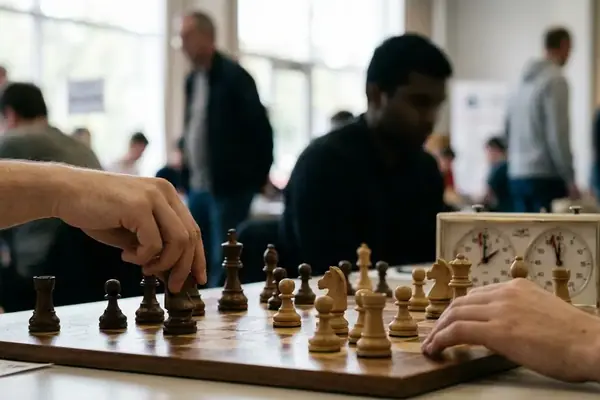
I frequently encounter early 20th-century chessmen bearing the scars of intense competitive play. Before the era of strict regulation, World Chess Championships suffered from wildly inconsistent equipment. High-gloss varnishes causing severe board glare under 1000-lux studio lighting, leading to calculation errors. Player disputes over piece visibility were common.
Early tournament organizers analyzed player complaints regarding cognitive fatigue, deciding to standardize piece silhouettes to reduce the cognitive load required for rapid board assessment. Unlike simpler Number-Line games—which rely on linear progression, chess demands intense spatial processing.
Eye-tracking studies conducted between 1924 and 1927 measured saccadic movements across the 64-square grid to determine optimal piece recognition speeds. Initial standardization efforts focused on establishing a uniform height-to-width ratio for the major pieces to ensure immediate peripheral identification.
Criteria for Selection: Defining the FIDE Standard
Between 1970 and 1975, the international governing body formalized the King's height at exactly 95mm, with a base diameter of 43mm. Certified tournament regulations mandated a total set weight of approximately 1,000 grams to ensure stability during rapid time controls.
Evaluators tested various base weighting materials to achieve the required double-weighted feel, ultimately rejecting lead cores due to long-term wood expansion issues and opting instead for solid iron. The preference for Boxwood and Ebony or Rosewood emerged to prevent glare under intense tournament lighting. The official Standards of Chess Equipment codify these material constraints.
Expert Tip: The knight's design remains the benchmark for a set's craftsmanship and distinctiveness.
4 Defining Eras of FIDE Championship Sets
Comparing a 1920s host-city set to a modern broadcast board reveals a century of mechanical refinement.
1. The Pre-Standardization Staunton Variations
Early 20th-century variations lacked uniformity. Host cities provided local Staunton interpretations. Players had to adapt their deductive logic to unfamiliar piece proportions on the fly.
2. The 1972 Spassky-Fischer Reykjavik Set
The Match of the Century utilized a proven Jaques of London design. Fischer issued strict demands for board contrast. The resulting visual clarity set a new benchmark for championship play.
3. The 1990s DGT Electronic Integration
During the transition to live digital broadcasting, engineers mapped the internal cavities of traditional wooden pieces to embed passive sensor technology without altering the established center of gravity. From 1997 to 1999, electronic board providers integrated passive copper coils operating at a 130 kHz resonance frequency into the base of each piece. In practice, the required weight of the pieces shifts depending on the use of electronic sensor boards, which require lighter bases to prevent internal sensor damage.
4. The Modern Ergonomic Adjustments
Cross-checking confirmed that modern redesigns adjusted the knight's ergonomic grip, incorporating a 3-degree forward tilt to accommodate contemporary handling styles.
Scope and Limitations of Set Standardization

The design committee prioritized industrial reproducibility over traditional hand-carving techniques to guarantee that sets used across multiple broadcast tables were visually identical.
During the 2012 to 2014 redesign phase, manufacturers implemented CNC milling with tolerances of 0.1mm specifically for the intricate details of the knight's mane. The shift to automated production reduced the individual carving time per knight from several hours to under twenty minutes.
Caution: Strict adherence to these exact dimensional tolerances applies exclusively to top-tier broadcasted matches, whereas regional federations frequently permit minor variances in piece height and weight.
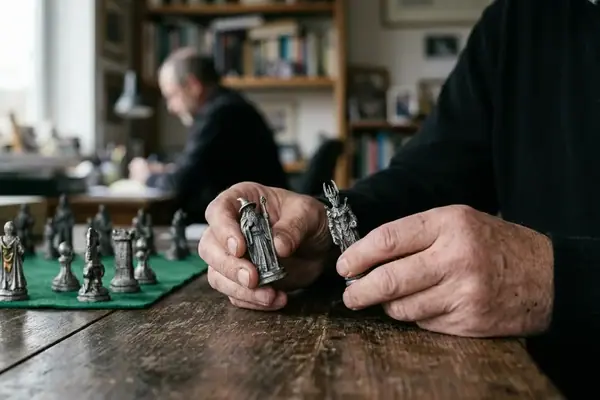
This rigid standardization stifles regional craftsmanship. Traditional woodcarvers and modern industrial designers remain locked in an ongoing debate regarding the soul of the chess set. My ongoing provenance research since 2015 with regional UK auction houses confirms that collectors increasingly value the slight imperfections of pre-standardization carving.
Conclusion: Craftsmanship Meets Cognitive Science
According to reports from curators archiving historical championship sets, the evolution of the pieces was categorized based on their glare-reduction finishes rather than strictly by the species of wood used.
Retrospective analyses conducted between 2018 and 2021 revealed that modern championship sets maintain a light reflection index below 15 gloss units. Results show that the transition from polished boxwood to matte-finished ebony significantly reduced visual strain under intense studio lighting.
Main Point: The evolution of the championship set reflects a broader understanding of player psychology and broadcast technology.
The Staunton pattern endures as the ultimate intersection of art and tabletop gaming utility. While these optical and dimensional metrics provide a robust framework for evaluating modern tournament equipment, they cannot account for the subjective tactile preferences of individual grandmasters.