
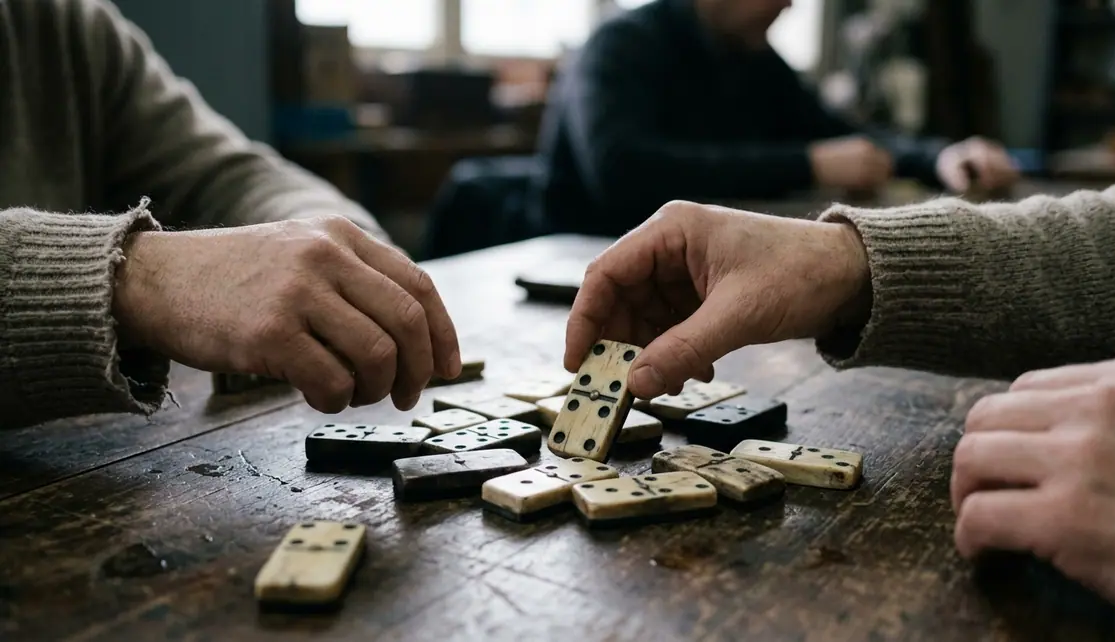
Pick up a domino from a pre-war set and you feel the argument before you read it. A traditional composite tile lands somewhere between 14 and 18 grams; a modern hollow plastic piece often comes in under 8. That gap is not trivia. It dictates how the tile sits, how it slides, and how long it takes your hand to commit to a move.
I came to dominoes through chess analytics, where I spend most of my time quantifying decision latency under load. What surprised me is how much the physical object governs the pace of play. The weight, the sound, the slight resistance of a tile against felt — these are not decorative. They are part of the game's clock.
The Tactile Legacy of the Game
Most collector guides start with appearance. I start with the hand and the ear, because that is where the experience actually lives.
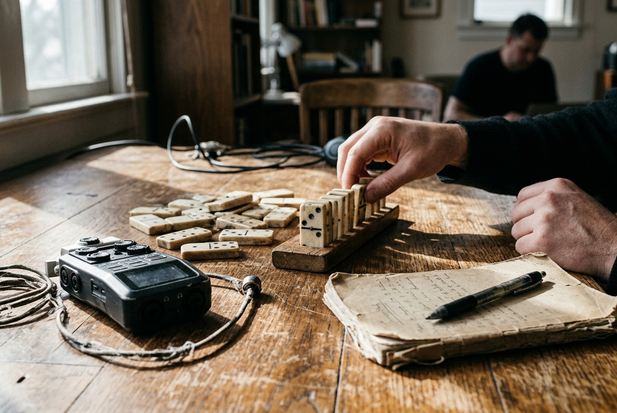
The iconic clack of a tile on bare hardwood is an acoustic event with a measurable signature. Dense materials produce a sharp resonance that peaks between 2.5 and 4.0 kHz on impact with a wooden table. Players don't think about frequency bands, of course, but they respond to them. A heavy tile that lands with a clean report tells you the move is final. A light, dull plastic piece offers no such confirmation.
This sensory layer disappeared fast. The shift from hand-crafted organic materials to mass-produced synthetics happened mostly between 1945 and 1960, compressing centuries of craft into a single postwar generation. Before that, the material was the manufacturer's signature.
Criteria for Evaluating Domino Materials
I built my evaluation framework around physical mechanics, not visual grading. A set can photograph beautifully and play poorly. The reverse is also true.
Acoustic Resonance
How a tile sounds when shuffled or played carries the atmosphere of a match. The resonance peak in the 2.5 to 4.0 kHz range is the marker of a high-density material doing its job. Context matters here more than collectors admit: the same Bakelite tile sounds entirely different on a felt-lined table versus bare hardwood, the felt absorbing the very frequencies that give the bare-wood clack its bite.
Density and Weight
Heft keeps tiles stable during complex chain builds. When you are extending a line across a crowded board, a tile that wants to stay put is doing real work. This was understood early. Standardized club play criteria for tile weight and stability were largely codified between 1890 and 1915, well before any synthetic alternative existed.
Durability
Vigorous shuffling chips and scratches faces. A material's resistance to that abuse determines whether a set survives decades of play or becomes a display piece after a single season. I weigh durability against the other two, never above them — a tile that survives everything but sounds dead is a poor choice.
1. Bone and Ebony: The Classic Standard
The classic standard solved a manufacturing problem elegantly. Solid bone warps. Builders responded with two-piece construction: a thin layer of animal bone pinned to a thicker ebony base. The bone gave a bright white playing face; the ebony gave weight and stability the bone alone could not.
The brass spinner is the part collectors underrate. That central pin typically protrudes 1.5mm to 2.0mm from the face, serving as a pivot point during shuffling and shielding the carved pips from friction. Without it, the faces would wear flat within a few years of heavy use.
The combination of dense wood and hard bone produces a layered acoustic profile — the bright crack of the bone over the lower body of the ebony, that no single material reproduces.
Peak production of these pinned composites ran from 1860 to 1920. They remain, in my assessment, the benchmark against which other materials are judged.
Caution: The two-piece design carries a built-in failure mode. Bone and ebony expand at different rates, so in fluctuating humidity the bone layer can separate from its base. A set that survived a century in a stable cabinet may delaminate within a year of moving to a damp room.
2. Historical Ivory: Scope and Limitations
Luxury sets from the 18th and 19th centuries often used ivory, and the material's properties explain its appeal. Elephant ivory carries a specific gravity of roughly 1.7 to 1.9 g/cm³, giving it a heft and a cool, dense feel that early plastics could not match.
I treat these strictly as historical artifacts, not play pieces, and I align that judgment with museum conservation standards rather than market enthusiasm. The reasons are legal as much as ethical. Major international trade restrictions tightened between 1975 and 1990, and they have not loosened since.
Caution: International conservation laws strictly prohibit the cross-border sale or transport of these sets without extensive, pre-1947 provenance documentation. A collector without that paper trail is not a collector but a liability.
So the practical guidance is narrow. Admire ivory sets in institutional collections. Do not attempt to acquire or travel with one unless you possess airtight documentation and a clear understanding of the relevant statutes.
3. Bakelite and Catalin: The Golden Age of Plastics
The plastics era was not a decline. For a stretch it was a genuine high point. The industry adopted synthetic polymers because they delivered uniform density and eliminated the labor of hand-carving, and the early results were excellent.
Bakelite holds a consistent specific gravity of 1.25 to 1.30. That consistency means identical weight distribution across all 28 pieces — something organic materials, with their natural variation, never quite achieved. The feel is heavy and the acoustic resonance is deep and distinctive.
The golden age of cast phenolic resin dominoes ran from 1925 to 1945. Catalin, the marbled cousin of Bakelite, earned a second life among collectors for its swirled colors, which industrial plastics later abandoned in favor of flat uniformity. Those marbled tiles now command attention that has little to do with how they play and everything to do with how they look under light.
4. Hardwoods: Regional Craftsmanship
Hardwood sets tell a regional story. As localized domino variations proliferated between 1930 and 1955, craftsmen reached for whatever dense local timber was available — rosewood, mahogany, walnut, sometimes ebony itself.
The premium examples use woods with a Janka hardness rating between 2,700 and 3,200 lbf. That hardness matters because the best makers left the surface unvarnished, preserving the wood's natural acoustic character rather than coating it in a layer that would deaden the sound.
Wooden tiles play lighter than bone or Bakelite, with a softer report. Some players prefer this; the gentler clack suits a slower, more contemplative game. What sets hardwood apart is tactile warmth and visible grain — every tile carries its own pattern, so no two sets are identical even from a single workshop. For collectors who value individuality over uniformity, this is the appeal.
Preserving and Selecting Your Set
Preservation comes down to environmental stability. I adapted these guidelines from institutional archival practice, scaled for a private cabinet rather than a climate-controlled vault.
- Maintain a stable relative humidity between 45% and 55%. This single measure prevents the cracking and delamination that destroy organic and composite sets.
- Allow antique composite sets an acclimatization period of 3 to 6 months when moving them to a significantly different climate zone. Rushing this invites the bone-and-ebony separation described earlier.
- Keep bare-hardwood and felt surfaces both available if you can, since the playing surface changes the acoustic profile as much as the tiles themselves.
Expert Tip: Match the material to the play style. For vigorous club games where tiles get shuffled hard, heavy synthetics like Bakelite absorb the abuse and stay consistent. For display or careful play, the delicate antiques reward gentle handling — but reserve them for occasions, not weeknight matches.
Main Point: The figures here describe broad material categories, and individual sets vary with their maker and their history; treat the ranges as orientation, not certification of any single tile. Preserving these materials is finally an act of respect. Each pinned spinner, each marbled swirl, each unvarnished grain pattern records a decision a craftsman made about how the game should feel in the hand. Keeping those decisions intact honors the artistry that mass production set aside.