
Astana, Game 4: The Move That Defied Logic
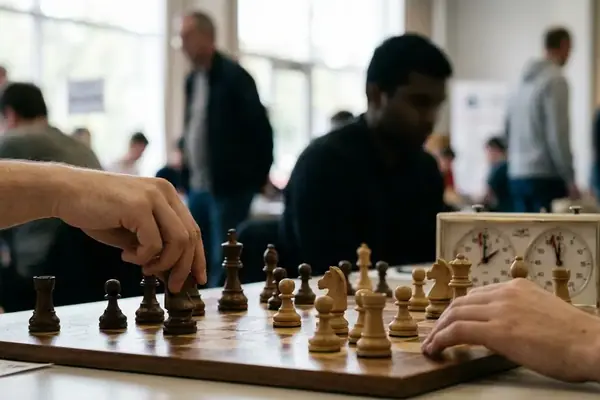
April 30, 2023. Astana, Kazakhstan. The final rapid tiebreak of the World Chess Championship has reached its critical juncture. The first three games ended in draws. Playing Black, Ding Liren faces a board where a repetition of moves offers a safe, guaranteed draw. He has approximately one minute and twenty seconds remaining on his clock, sustained only by a ten-second increment per move. He plays 46...Rg6.
This active refusal to repeat the position marks the climax of a grueling ordeal. The complete contest spanned 14 classical games and four rapid tiebreaks. The physical and cognitive toll of 18 high-stakes games across 22 calendar days is visible at the board. The risk calculation behind 46...Rg6 depended entirely on a tied match, the final scheduled rapid game, and that fragile 10-second increment. It stands as a specific adaptation to extreme circumstances rather than a general argument for refusing repetitions in ordinary tournament positions.
The Improbable Challenger: A Qualification Scramble
Twenty-eight classical games played in 29 calendar days. That data point establishes the baseline of chronic pressure Ding endured before the championship cycle even began. Following Magnus Carlsen's abdication and a subsequent disqualification that created a rating-based vacancy, Ding faced a severe logistical hurdle.
He needed 26 additional rated classical games to meet FIDE's rating activity requirements for the eight-player qualifying tournament. From March 27 through April 24, 2022, he executed a frantic domestic schedule to reach the 30-game threshold. The Candidates Tournament followed shortly after, running from June 17 through July 5. This compressed timeline left less than three months between the activity scramble and its conclusion.
Preparation Leaks and Psychological Fractures
The opening phase of the match exposed a dual crisis of clock management and preparation security. After Ding employed the unusual 4.h3 in Game 2, analysts quickly located public online training games containing closely related lines. This exposure became public between April 10 and April 12. The overlapping online lines indicate that preparation secrecy was weakened, though months of theoretical work remained viable.
Broadcast footage frequently showed Ding spending unusual amounts of time in the resting room. Camera feeds establish only a player's physical location; move-time data and post-match interviews provide firmer evidence of his state during play. A review of the broadcast clock records shows that the fracture materialized in Game 7 on April 18. Ding spent roughly five minutes calculating 32...Rd2. He emerged with under one minute to execute eight required moves. He lost on time on move 37, failing to reach the move-40 control.
Strategic Takeaway: Clock Management Under Pressure
Game 7 stands as the primary failure case of the match. Preparation support and emotional grounding failed to prevent Ding from spending nearly all his remaining time on a single move, leading directly to a clock defeat.
The Rapport Effect: Shifting from Engines to Emotion
Hiring Richard Rapport as a second introduced a deliberate shift toward creative, over-the-board problem solving. Rapport built his reputation on irregular opening ideas and tactically unbalanced structures. Together, they constructed a repertoire designed to bypass Ian Nepomniachtchi's deep engine preparation.
The recovery strategy produced immediate results. Ding secured his first win in Game 4 on April 13. An English Opening developed into an imbalanced middlegame, where 28.Nd5 initiated an exchange sacrifice that secured lasting activity for White. Three days later, in Game 6, Ding utilized a London System structure to win in 44 moves, finishing with a decisive 44.Qf7. Both victories occurred within a four-day window following his Game 2 defeat. This partnership prioritized emotional grounding. It allowed Ding to manage the cognitive load of playing from behind, relying heavily on deductive logic rather than pure engine memorization.
Tactical Compartmentalization in the Late Stages
Game 12 provides the clearest operational example of tactical compartmentalization. On April 26, Nepomniachtchi led the match 6-5 with only three classical games remaining. Ding entered the game a full point behind. He navigated a position that shifted violently from promising to deteriorating, and finally to winning. He secured the victory in 38 moves.
Calculating complex variations while emotionally exhausted requires the mechanical ability to reset board evaluations after catastrophic errors. Unlike linear Number-Line games where progress is strictly cumulative, elite chess demands the capacity to treat each new position as an isolated puzzle. Ding drew Game 13 the following day. On April 29, he defended a grueling 90-move Game 14 to force the rapid playoff.
The Ultimate Metric of Resilience
The recovery unfolded through repeated score repairs rather than sustained control. Ding answered his deficits with precise counter-strikes:
- Lost Game 2, won Game 4.
- Lost Game 5, won Game 6.
- Lost Game 7, won Game 12.
The 14 classical games ended 7-7, featuring three wins for each player and eight draws. On April 30, Ding won the four-game rapid playoff 2.5-1.5. Ding Liren became the 17th FIDE-recognized undisputed World Chess Champion without ever leading the match at any point during the 14 classical games. His first lead came only when the final rapid game had already ended.