
The Clock, the Board, and 35 Branches
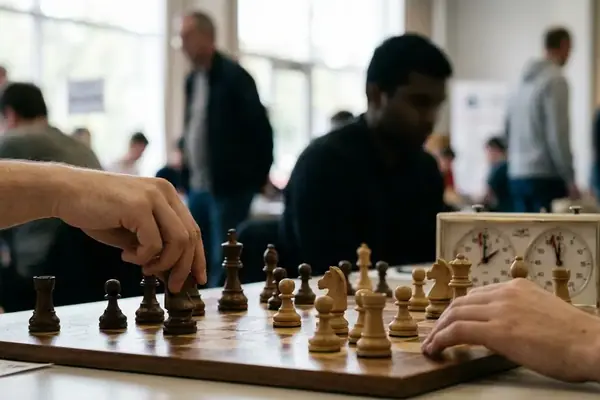
A tournament player leans over a complicated middlegame while the clock sheds seconds. The opponent’s last move attacks something, perhaps directly, perhaps through a discovered threat. Checks appear on both wings. A central pawn break looks tempting. Several pieces remain loose enough to turn one inaccurate move into a tactical collapse.
The position may offer roughly 30 to 35 legal choices. With a fixed branching factor of 35, an eight-ply search—four moves for each player, produces 2,251,875,390,625 leaf sequences before accounting for transpositions or early endings. Claude Shannon’s order-of-magnitude estimate placed the complete chess game tree near 10120 possible games.
Search Begins With Exclusion
Those figures define the real calculation problem. The player must decide which branches deserve attention. Exhaustive search has no practical role at the board.
With five minutes available, a workable sequence assigns 20 to 40 seconds to immediate threats, 30 to 60 seconds to candidate generation, and the remaining three to four minutes to verification and a final blunder check. The first scan covers checks, captures, direct threats, and strategically plausible improving moves. Every irrelevant branch removed at this stage preserves attention for a line that might alter the evaluation.
Decision fatigue develops when the candidate list stays open too long. Players revisit rejected moves, calculate hopeful replies, and lose track of move order. Cognitive pruning is the mechanism that keeps the position finite enough to play.
How Positional Cues Shrink the Tree
Strong calculation often looks surprisingly selective. Classic think-aloud experiments recorded the first candidate named, the variations verbalized, and the move eventually chosen. Stronger players did not merely inspect every legal move more deeply. Their initial candidates aligned more closely with the position’s critical features.
A Stable Diagnostic Order
A positional heuristic is an internalized rule of thumb tied to pattern recognition. Before calculating, the player classifies king exposure, pawn breaks, weak squares, loose pieces, open files, space, and the least active piece. A stable routine matters because it reduces the chance that an attractive local tactic obscures a larger structural problem.
The usable inventory is concrete: isolated and backward pawns, passed-pawn creation, open and half-open files, protected outposts, color-complex weaknesses, overloaded defenders, unprotected pieces, and the balance of attackers and defenders near each king. These cues support deductive logic. They turn a vague intention such as “attack the king” into a calculable candidate such as opening a file or forcing the exchange of a key defender.
In a familiar middlegame structure, candidate generation should usually consume 15 to 45 seconds and produce two or three moves. A move that exposes the king, loses material without compensation, or fixes a structural weakness receives no deep search unless a tactical feature justifies the cost.
This is the central finding in decision-tree research: expertise improves the quality of the search frontier. Masters spend their calculation budget on branches with a credible positional basis.
Where Pattern Recognition Loses Authority
A protected outpost can be irrelevant when mate is threatened. A healthy pawn structure carries little weight during a promotion race. Sharp positions change the order of operations because forcing moves constrain both players.
The Tactical Exception
Checks come first, followed by captures and direct threats. At every ply, the search must account for zwischenzugs, discovered attacks, deflections, overloaded defenders, back-rank motifs, and promotion threats. The endpoint becomes meaningful only after tactical contact has ended. Material balance, king safety, pawn structure, and surviving initiative can then be evaluated.
This is the pruning boundary between an isolated-pawn heuristic and the tactical exception that demands checks-captures-threats verification. An apparently unsound sacrifice deserves calculation when it opens a forcing line. Conversely, an aesthetically pleasing developing move deserves immediate rejection if one checking reply breaks the position.
Engine comparison exposes these blind spots with unusual clarity. The principal variation matters more than a bare evaluation score. A shift from favorable to losing after one reply often identifies a missed tactical resource. Small changes across successive search depths may instead reflect unstable move ordering.
Engine evaluations provide a stringent analytical reference, with conclusions shaped by search depth, hardware, evaluation settings, and access to endgame tables. Their use in human cognitive comparison is cleanest in classical sessions offering roughly 90 to 120 minutes for the first 40 moves. Blitz and rapid formats entangle search quality with severe clock-management effects.
A difficult classical middlegame may justify two to six minutes of tactical verification. The final 20 to 30 seconds belong to one narrow question: after the intended move, what checks and captures does the opponent gain?
Turning Two Candidates Into One Move
The combined method has four transitions: diagnose the position, nominate candidates, calculate forcing replies, and compare endpoints. Each transition closes one mode of thought before the next begins.
Write the Line as a Proposition
Candidate selection uses pattern recognition to identify two or three plausible moves. Active calculation then tests each move against the opponent’s strongest response rather than the convenient reply the player hopes to see.
I find the cleanest mental format resembles a compact proposition: intended move, strongest reply, continuation, endpoint evaluation. For example: open the file; meet the checking reply; exchange queens; reach a rook ending with an active king. This format preserves the purpose of the line when several branches share similar move orders.
With eight minutes available, 45 to 75 seconds can cover diagnosis and candidate selection. Calculation receives five to six minutes, followed by a 30- to 45-second legality and blunder check. The allocation prevents an interesting first candidate from consuming the entire clock.
A branch reaches a useful stopping point when forcing moves have run out and the resulting position can be judged through material, king safety, pawn structure, piece activity, and tactical residue. Once a clear refutation appears, stop. Extending a dead line adds cognitive noise and increases the chance of carrying an illegal or imagined variation into the final comparison.
The practical sequence is the 35-branch, eight-ply explosion compressed into two or three candidates, one forcing reply at a time.
Build the Pattern Library Before Chasing Speed
Contextless calculation puzzles reward tactical detection after someone else has already declared that a tactic exists. Tournament positions provide no such signal. The critical move may be a pawn break, a defensive exchange, or a quiet prophylactic move that never appears in a puzzle-shaped search.
Study Decisions Inside Real Structures
Annotated master games supply the missing context. At each critical position, pause for three to five minutes, record two or three candidates, and attach a short evaluation. Then compare the candidate set and reasoning with the annotation. The useful discrepancy is often the move omitted before calculation even started.
A focused 75- to 105-minute session can devote 45 to 60 minutes to one annotated game, including pauses at six to eight critical positions. Use the final 20 to 30 minutes to recalculate positions where the candidate list missed the played move. Preserve four items in the review record: the first candidate considered, the positional cue that generated it, the opponent’s strongest reply, and the first point where the line diverged from the annotation or engine check.
Structure the work in clusters of five to ten games sharing the same positional theme. Isolated queen’s pawn positions teach recurring breaks and blockades. Minority attacks clarify target creation. Opposite-side castling trains threat comparison, while rook-on-the-seventh positions sharpen judgments about activity and king exposure. Repetition converts individual examples into retrievable patterns.
Calculation speed becomes valuable after this pattern library can generate the right moves. Make annotated master games the core of the training schedule, and use calculation exercises afterward to verify the candidate moves those games teach you to see.