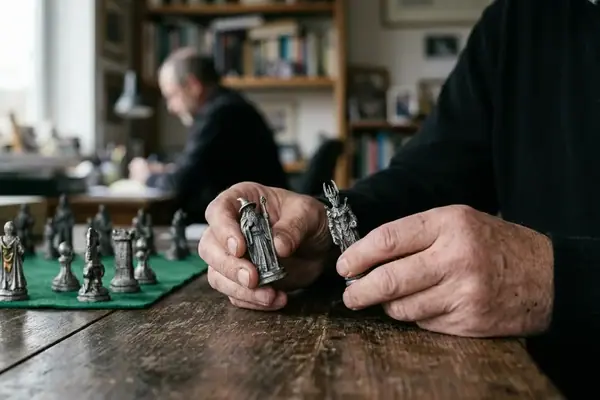

Engineering the 1849 Standard
Lift a tournament-grade King by the stem, set it down without guiding the base, and apply a light lateral nudge. A properly crafted piece settles immediately into a stable footprint. A poorly executed replica of the exact same height feels hollow and tips over. This handling character stems directly from the transition between the varied, top-heavy chess patterns of the 1820s through 1840s and the commercial introduction of the Staunton pattern in 1849.
Unlike simple Number-Line games where piece stability is secondary, chess demands a physical interface that withstands rapid, high-stakes play. The design decision begins with play rather than ornament. Makers establish a stable footprint, place enough mass near the board, and shape the stem, collar, and crown so the King remains comfortable to lift.
Height alone fails as a quality measure—two Kings can both stand 95 to 102 millimetres tall while differing substantially in base width, center of gravity, and resistance to tipping. A direct handling comparison takes five to ten minutes on a level board. You lift each King repeatedly by the stem, setting it down without guiding the base, and applying the same light lateral nudge. The physical feedback immediately reveals the internal engineering. A well-balanced piece absorbs the kinetic energy of the move, anchoring itself firmly to the square.
Dimensional Cascades Across Ranks
Drawing on official tournament equipment standards, the standard specifies a King height of 95 millimetres, permitting a variation of one tenth in either direction. This standard pairs with a base diameter between 0.4 and 0.5 of the piece's height. A maker establishes the King as the dimensional envelope, selects this base-to-height relationship, and reduces the remaining ranks without erasing their identifying geometry. The Queen remains close to the King in scale at approximately 85 millimetres. The hierarchy descends in controlled steps: 70 millimetres for the Bishop, 60 for the Knight, 55 for the Rook, and 50 for the Pawn.
The completed army must then match the intended square size. An internally consistent set fails if it crowds the board. Tournament board squares commonly measure 50 to 60 millimetres wide. Traditional set-to-board appraisal looks for a King base measuring roughly three quarters to four fifths of the square width. A 44-millimetre King base on a 57-millimetre square yields a diameter-to-square ratio of about 0.77. This circular footprint occupies less than the full square and leaves visible clearance at all four corners. Testing the complete back rank on the intended board takes three to five minutes. This test ensures players can lift the King and Queen cleanly while pieces remain on adjacent files.
Concentric Ballast and Timber Density
After turning the external profile, the craftsperson drills a concentric cavity through the underside of the base and trial-fits a metal insert. The weight cavity sits exactly on the piece's vertical axis. An off-centre insert forces the piece to favour one direction even when its external turning is perfectly symmetrical. Moving added mass toward the underside lowers the combined center of gravity. During a lateral disturbance, the piece returns upright as long as the center-of-mass projection remains inside the supporting footprint. Once that projection crosses the pivot edge, the piece falls.
A practical workshop sequence uses two balance checks over 10 to 20 minutes. The maker performs one check after trial-fitting the insert and another after fitting the base covering. The insert is secured only after the return action feels positive and the piece lands without an abrupt, base-heavy thud. Dense African blackwood contributes substantially more body mass than a geometrically equivalent piece turned from lighter boxwood.
The artisan must assess the finished mass distribution rather than copy an insert weight from another timber. While precise center-of-mass calculations offer a baseline, timber moisture content and cavity depth introduce unavoidable variances in final weighting. There is no defensible universal gram target for a Staunton rank. Timber species, moisture content, cavity depth, metal density, crown geometry, and base covering all change the amount of ballast required for the same balance point. The blackwood-to-boxwood mass boundary dictates that identical King height and base geometry do not justify an identical metal insert or finished gram weight.
Peripheral Identification of Lathe Profiles
In complex positions requiring intense deductive logic, distinct, standardized silhouettes reduce cognitive load for players and allow for instant peripheral piece recognition. The Staunton vocabulary assigns each rank a different dominant contour before decorative detail is added. Pawns receive compact spherical heads recognizable from every rotation. Bishops feature a diagonal slot that interrupts an otherwise smooth pointed head. Rooks utilize a low cylindrical tower where a crenellated crown produces a broad, notched top edge. Kings and Queens separate through terminal geometry. The King's cross-like finial and the Queen's coronet remain distinguishable when their stems and bases appear similar.
The Knight serves as the aesthetic centerpiece and a highly distinct visual anchor. Its ears, brow, muzzle, mane, and forward orientation generate multiple contour changes absent from the lathe-turned ranks. This asymmetric horse-head profile prevents board confusion and remains distinctive even when fine incised details fade into the background. A silhouette check takes five to eight minutes. Backlight the arranged set, view it from both players' sides, and confirm that every rank remains identifiable without relying on wood colour. This sequencing preserves rank recognition when carving detail is lost to distance or visual overlap.
Executing a Physical Geometry Audit
Begin the audit on a level, felt-safe surface within 24 to 72 hours of unpacking. Testing early ensures display handling or felt wear does not obscure an original manufacturing defect. Examine balance before judging carving. The complete three-stage audit takes approximately 10 to 15 minutes.
Square Ratio Clearances
First, perform the tilt test. Move the King slowly until its central axis reaches approximately 45 degrees from vertical. Release it without an added push. Observe whether it returns upright, hesitates, or continues over the base edge. Run this test three times in different rotational positions over two to four minutes. Direction-dependent results reveal an eccentric weight, an uneven felt pad, or an asymmetric base.
Second, place the King on the intended board to measure base diameter and square width. Divide the King base diameter by the square width. Test board spacing with the complete back rank present. Lift the King, Queen, and both Bishops without moving neighbouring pieces. Third, check silhouette alignment. Place a straightedge behind the Pawn row or use a low backlight. Measure the tallest and shortest Pawn with callipers and record the spread rather than relying on an unaided overhead view.
To audit a newly acquired 95-millimetre boxwood set, place a 55-millimetre square board on a flat table. Measure the King's base with digital callipers; a reading of 43 millimetres yields a 0.78 ratio, leaving clear corner clearance. Set up the full back rank and lift the Queen vertically to ensure your fingers do not brush the adjacent King or Bishop. Next, tilt the King toward the e4 square to a 45-degree angle and release it. Repeat this tilt toward the d4, e5, and d5 squares. If the King snaps back to vertical from all four directions without hesitation, the result is consistent with centered under-base ballast. Finally, align all sixteen Pawns against a steel ruler, shine a desk lamp from behind, and measure the height of the tallest and shortest spheres to verify the dimensional envelope remains consistent across the front line.