
The Psychological Weight of Time Trouble Mechanics
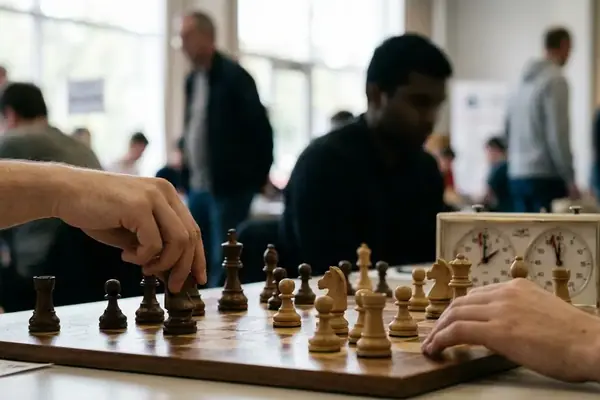
What exact level of mechanical precision is required to manage the cognitive load of a grandmaster in severe time trouble? The answer lies in the physical sequence of a single move. A player must calculate the position, physically grasp and move the piece, release it entirely, press the clock lever with that exact same hand, and immediately return their attention to the board. Under the Laws of Chess, pressing the clock before releasing the piece does not constitute a completed move sequence. The equipment succeeds only when that entire physical chain requires absolutely no visual confirmation.
When a player enters a severe-time-trouble window of 5 to 30 seconds remaining, the hardware must become an invisible extension of their thought process. The tactile feedback of the equipment dictates the rhythm of the endgame. A classical playing session can occupy four to six hours. Over that duration, glare from a board, the faint ticking of a clock, unstable pieces, and awkward lever controls impose repeated cognitive costs rather than a single isolated inconvenience.
Loose, lightweight pieces and analog clocks fail under this physical stress. The player's working memory is already saturated with variations, deductive reasoning paths, and threat detection. Forcing them to consciously verify that a piece has remained upright or that a clock button has fully depressed drains the exact mental resources needed to find the winning continuation. The physical environment must absorb the mechanical friction of the game, leaving the player's cognitive capacity entirely dedicated to the position on the board.
Geometry and Glare in Regulation Play
A regulation-style board with 50 to 60 millimeter squares yields a playing area of 400 to 480 millimeters per side before any border is added. Selection begins with this geometry rather than ornament. You match that square size to a Staunton king approximately 95 millimeters high. The critical metric is the optimal footprint. The king’s base must occupy roughly three-quarters to four-fifths of a square without crowding adjacent pieces. Practical board matching keeps the base near 75 to 80 percent of one square’s width. This specific ratio ensures that the board feels neither sparse nor congested, allowing the visual cortex to quickly parse diagonals and files through chunking.
After establishing the fit, the playing surface requires rigorous inspection under overhead lighting. Glossy lacquer produces bright reflections across dark squares, obscuring the position and accelerating visual fatigue. Inspect the board for glare for 30 to 60 seconds from both players’ seated positions, not only from directly above the center. The finish should absorb light, presenting a matte or satin surface that maintains high contrast between the pieces and the squares regardless of the ambient room lighting.
The baseline technical requirements for tournament clocks demand the ability to handle complex multi-stage time controls. A tournament clock should support at least an initial period, a move-count transition, a second period, and a per-move increment or delay. A useful verification program is 90 minutes for 40 moves, followed by 30 minutes, with 30 seconds added from move one. Drawing on a review of the FIDE Handbook, these geometric tolerances ensure uniform conditions across international events. The 55 millimeter square, the 95 millimeter king, and the 30-second increment chain form a unified system. Board geometry, piece stability, and clock arithmetic must be tested as one tournament system.
Engineering the Tactile Toggle
With a 30-second Fischer increment, a move completed in 8 seconds produces a net gain of 22 seconds on the display. Compare this to a 30-second Bronstein delay, where that same 8-second move generally restores the 8 seconds used but does not create a 22-second surplus. The clock must handle this arithmetic flawlessly while providing immediate physical feedback. The engineering of the toggle mechanism dictates how confidently a player can strike the clock and return to the board.
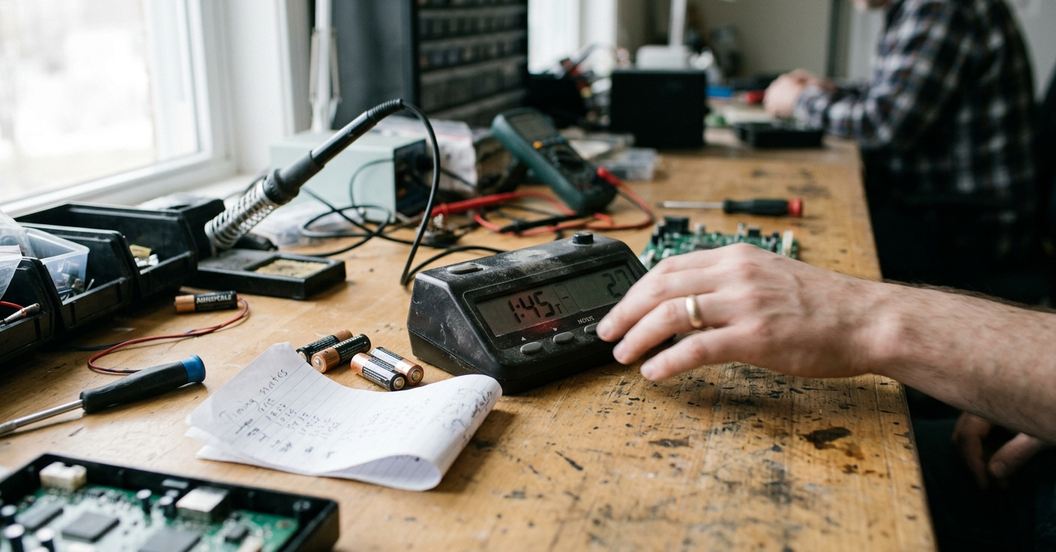
Tournament-grade clock evaluations prioritize battery reliability and intuitive interface design over aesthetic novelty, though these criteria apply specifically to classical time controls rather than blitz variants. The review process begins with a fresh-battery power test. We then run 20 to 30 alternating lever presses during inspection. The goal is to watch for missed transitions, double activation, rocking, or a lever that requires uneven force. Each press must change the active display immediately. A crisp, tactile click is essential for players to confirm their move without looking away from the board. The mechanical resistance of the lever must be balanced—too stiff, and it disrupts the player's physical rhythm; too loose, and it risks accidental double-activation.
An arbiter must be able to edit the interface without consulting a manual. We program a two-stage control and advance it through the move-count boundary over a 5 to 10 minute bench test. This verifies the move counter, the added period, the active-player indicator, and the low-time display behavior. Install batteries and power the clock on 15 to 30 minutes before the room opens. This buffer ensures that resets, dim segments, and incorrect presets can be corrected without delaying pairings.
Mass and Silhouette in Staunton Design
Choose pieces by stability and recognition first, then by wood and finish. Traditional premium sets use ebony or rosewood-family timbers for dark pieces and boxwood for light pieces. Trade restrictions and cracking risk make certified legally sourced material and controlled storage important purchasing questions. The density of these woods contributes to the physical presence of the pieces, grounding them firmly on the squares.
Set the king, queen, bishop, knight, rook, and pawn on adjacent squares to confirm that silhouettes remain distinct at a seated angle. For a 95 millimeter king, a base around 38 to 48 millimeters is consistent with the usual proportional range and pairs naturally with 50 to 60 millimeter squares. The visual hierarchy of the Staunton design relies on these precise proportions to allow instant piece recognition during rapid calculation.
The terms double-weighted and triple-weighted are not standardized mass classes. Compare actual piece mass, base diameter, center of gravity, and weight retention instead of treating those labels as precise measurements. Modern weighting commonly uses iron or steel inserts. Lead appears in some older pieces and should not be exposed during repair or refelting. A low center of gravity prevents pieces from tipping during rapid exchanges.
Test the set with 10 to 20 rapid capture-and-replacement motions. A suitable piece should settle upright without prolonged wobble. Its thick billiard-cloth felt should slide without scratching, bunching, or leaving adhesive on the board. This felting protects wooden boards and dampens sound in a quiet tournament hall. Condition wooden pieces and the board in the playing room for 12 to 24 hours before a formal event when they have arrived from markedly different temperature or humidity conditions.
Pre-Round Equipment Verification Steps
- Measure square width to confirm the 50 to 60 millimeter standard.
- Match the set to ensure the king is near 95 millimeters high with a stable, proportionate base.
- Check every piece for loose weights, rocking bases, damaged felt, and ambiguous silhouettes.
- Inspect the board and pieces from both seats for glare under the specific tournament lighting.
The Architecture of Live Broadcast Transmission
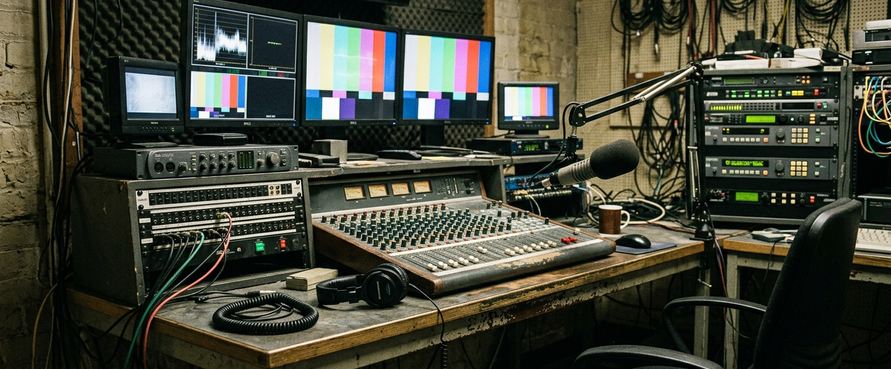
Building the broadcast path requires working from the physical position outward. You identify each piece, confirm every square sensor, connect the board to the collection computer, map the game to the correct board number, and only then publish the move feed. The identifiers inside wooden pieces are passive electronic resonators often described loosely as RFID. Coils beneath the board detect identity and location through electromagnetic induction. This allows a traditional wooden board to transmit a digital record of play.
A sensor board must distinguish 64 occupied or empty square states and identify piece type and color so that the software can reconstruct legal move sequences. Before play, make 2 to 5 test moves. Include a capture, castling, and a piece returned to its original square. Compare the physical position with the laptop display after each action. The system must track complex interactions without dropping the signal or misidentifying a promoted piece.
Allow 30 to 60 minutes before the round for cable checks, board-number mapping, starting-position validation, and feed recovery testing across multiple boards. Sensor boards are practical for elite invitationals and other productions with dedicated operators. Their purchase cost, cabling, software configuration, and troubleshooting burden usually outweigh the benefit for a weekly local-club round or casual home analysis. The sensor-board boundary runs between a 64-square live production with an assigned operator and an ordinary club table where cables and feed recovery add more work than value. Electronic transmission assists spectators and record keeping. It does not replace the arbiter’s observation, the players’ clock state, or the official procedure for resolving an illegal move or disputed result.
The Arbiter's Morning Inspection
At around 8:45 AM in a quiet hotel ballroom, the arbiter aligns the white rooks with the corners of a wooden sensor board. They check that the queens occupy squares of their own color and center the kings rather than merely glancing across the ranks. The final board, clock, and feed inspection concludes 15 to 30 minutes before players are admitted. The room is silent, with the equipment set for play.
The arbiter confirms all 32 pieces are present, verifies the correct lower-right light square, and ensures white pieces sit on ranks one and two. They check the clock placement on the side designated for the match. A 2 to 5 move transmission test runs through the system. The arbiter restores the initial position, resets both clock displays, and verifies that no test moves remain attached to the live game record. The physical setup must be ready before the first handshake.
Finally, they spend 10 to 20 seconds checking both lever directions after the final reset. The active display switches once per press without sticking or bouncing. The arbiter presses the digital clock's lever to ensure the tactile click registers instantly, pausing to verify the broadcast feed on a laptop before the players arrive.