

Exhibition Precedents and Observable Calculation Deficits in Club Play
In 1858, Paul Morphy sat in a Paris parlor and played eight opponents simultaneously without sight of the boards. Later, from the 1890s into the early 1900s, Harry Nelson Pillsbury built a professional career as another prominent blindfold exhibitor. These performances establish that sustained, board-free spatial tracking predates modern digital instruction by more than a century. While Soviet authorities enacted a prohibition on blindfold simultaneous exhibitions in 1930, reportedly on health grounds, that localized measure merely restricted extreme public displays. In local chess clubs today, the pedagogical issue is simpler: unassisted mental board representation rarely receives structured rehearsal.
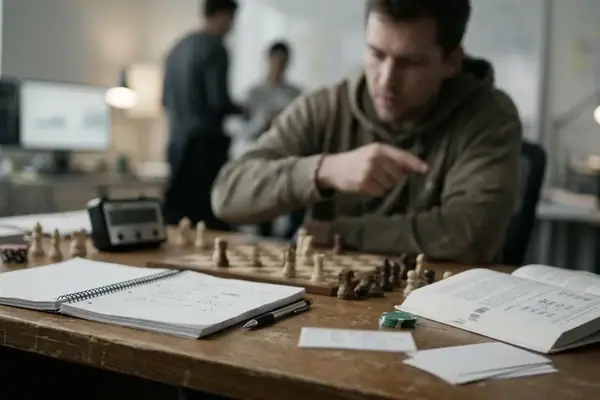
Coaches can inspect their own teaching environments to see where spatial tracking breaks down. During analysis sessions, instructors frequently rely on digital calculation arrows or immediate physical piece movement to demonstrate tactical lines. A practical local diagnostic reveals the cost of these visual aids. Before moving any pieces on a demonstration board, a coach can ask students to announce a variation aloud and then reconstruct the resulting position from memory.
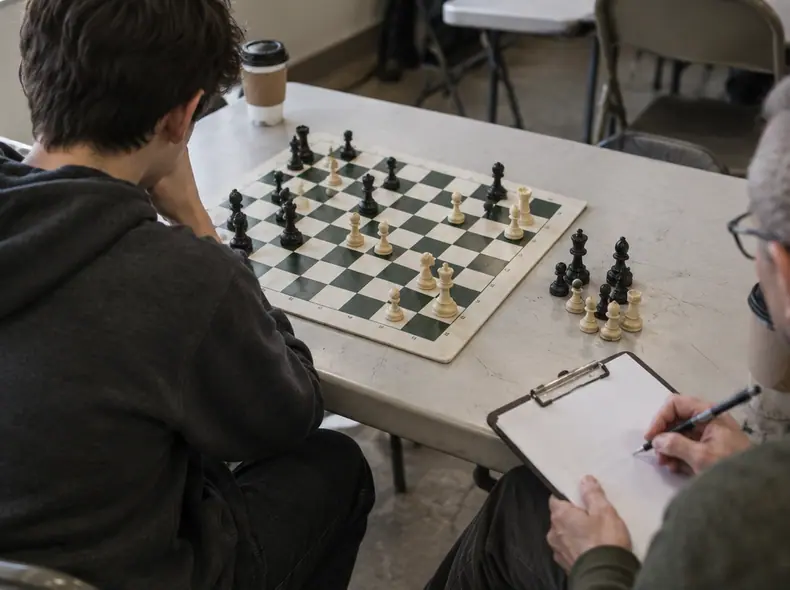
A three- or four-ply line serves as an effective initial diagnostic task. A ply represents a single player's move. When club players attempt to calculate four plies deep while staring at a static physical setup, blunders often emerge from degraded location tracking. After announcing the four-ply sequence aloud, the instructor asks the student to state the current squares of every moved piece, every captured piece, and both kings. When a player cannot accurately report which squares were vacated during the first two plies, deductive logic collapses before tactical evaluation can even begin.
Functional Chunking and Perceptual Interference in Spatial Updating
Consider a stripped-down board containing four pieces: a White king on g1, a White bishop on c2, a White pawn on e4, and a Black king on g8. The bishop's northeast ray runs through d3 and stops at the friendly pawn on e4. When White plays e4-e5 mentally, the instructional target is the immediate updating of functional relationships. The pawn now occupies e5, vacating e4, which allows the c2-bishop's ray to extend unobstructed through e4, f5, g6, and h7.
Skilled players maintain board-free positions through this type of relational encoding. Adriaan de Groot's foundational research, published in Dutch in 1946 and translated into English as Thought and Choice in Chess in 1965, connected chess expertise directly with structured perception and meaningful position recall. William Chase and Herbert Simon expanded this model in their 1973 paper, Perception in Chess. Their trials demonstrated a strong expert advantage in recalling meaningful game positions, paired with a much smaller advantage when pieces were placed in randomized arrangements. This disparity supports a cognitive account based on learned configurations—lines of force, pawn skeletons, and dynamic square control—where players hold legal, game-like arrangements in mind through chunked relationships.
Calculating over a physical board introduces a specific perceptual conflict. The visible wooden pieces supply the actual starting position, while deep calculation requires the player to track a hypothetical future state. Confusion between the physical board and the imagined state creates an interference problem: a player calculates a bishop sacrifice on h7, yet continues to treat the physical pawn on e4 as a blocker three plies later because it remains directly in their field of view. In cognitive psychology, the visuospatial sketchpad is analyzed as a component of working memory. In practical chess training, board-free exercises demand exact location updating supported by both learned visual patterns and verbal coordinate tags, stripping away the static physical state so the player must explicitly track every vacated and newly occupied square.
Diagnostic Markers for Spatial Buffer Overload Versus Coordinate Illiteracy
A common coaching failure occurs when an instructor mandates a full 64-square blindfold game for an unpracticed intermediate player. Thrown into an unstructured opening, the student quickly commits an illegal move or forgets a capture. Rather than letting a student struggle until the position collapses and then restarting the entire game, a precise methodology isolates the exact failure mode. When a learner loses the position during an exercise, the coach returns to the last correctly reconstructed state, logs the exact ply where the first incorrect update appeared, and categorizes the error.
Different tracking breakdowns require distinct corrective drills. During a two-minute diagnostic window, a coach records accuracy and self-corrections across three isolated tasks before interpreting response speed:
- Coordinate and Color Checks: Announce isolated squares such as a1, h1, c3, and f6. The learner must identify their colors: dark, light, dark, and dark. Errors on single coordinates point directly to coordinate or color-fluency difficulties rather than memory capacity limits.
- Single-Piece Trajectory Checks: Announce a knight on b1 followed by the sequence b1-c3-e4. Ask for the knight's final square and one legal destination from that point. This tests pure transitional tracking. If a student answers isolated coordinate checks accurately but fails here, or fails as a second piece enters the drill, the problem is an updating-load bottleneck.
- State-Update Error Logging: When multiple pieces interact, the coach must distinguish between three specific errors: a forgotten captured piece, a vacated square reported as still occupied, and a sliding piece moving illegally through a newly occupied square.
Capture-Removal Diagnostic
In the lingering-f7-pawn breakdown, a student hears the move Qxf7+ and correctly places the White queen on f7, but continues to calculate as if the captured Black pawn on f7 still exists. Logging this separately reveals a capture-removal failure rather than an inability to trace the queen's diagonal trajectory.
A Fifteen-Minute Board-Free Protocol for Weekly Club Sessions
To build spatial updating capacity without inducing rapid fatigue, clubs can open weekly meetings with a structured fifteen-minute module. While the expertise research cited earlier establishes how players store structured memory for chess positions, it does not confirm that this specific fifteen-minute routine improves tournament results or outperforms ordinary calculation practice; coaches should treat the module as a targeted diagnostic and coordinate-updating discipline. The protocol divides into two minutes of shared coordinate warm-up, ten minutes in an assigned proficiency tier, and three minutes of position reconstruction and error review. The four tiers below function as parallel difficulty tracks based on player readiness.
Tier 1: Coordinate and Trajectory Fluency
This track eliminates piece tracking entirely to build an instant verbal-to-spatial map. The coach gives the learner five to ten seconds per prompt as a session pacing setting. Prompts alternate between naming square colors, verifying diagonal membership, and calculating shortest knight routes. For example, the coach asks if c1 and h6 share a diagonal (they connect along the c1-d2-e3-f4-g5-h6 light-square line) or requests the shortest two-move knight route from a1 to c5 (solved by a1-b3-c5).
Tier 2: The Quadrant and Endgame Sandbox
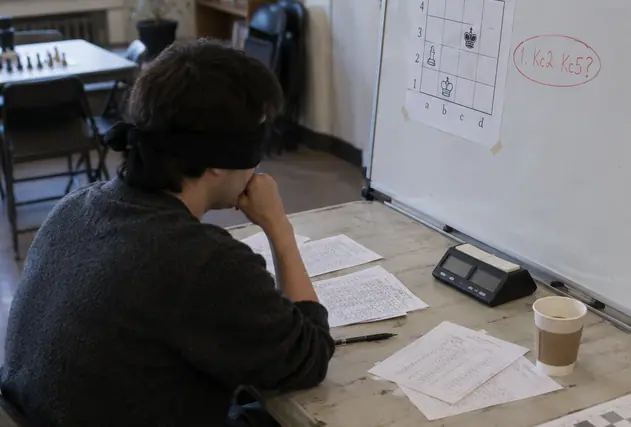
Tier 2 confines calculation to a 4x4 grid covering files a through d and ranks 1 through 4, treating the inner edges as hard boundaries. Set the initial mental position as White king on b2, White pawn on b3, and Black king on d4, with White to move. To verify boundary awareness, read the sequence 1.Kc2 Kc5? as an error-detection prompt. While Kc5 is a legal king move on a standard 64-square board, c5 lies outside the a1–d4 sandbox; distinguishing a boundary violation from a misunderstanding of king geometry keeps the spatial constraint tight. Restart the position and read the legal sequence 1.Kc2 Kc3 2.Kc1, asking the student to name all three piece locations after each single ply. To progress this drill, add a Black pawn on a4 to the initial setup, ask whether White can play b3xa4, and require the student to state which square becomes empty afterward.
Tier 3: Forced Tactical Tracking Over an Empty Grid
Players sit before an empty physical chessboard, which supplies visual coordinate scaffolding while withholding piece locations. The coach announces the complete initial placement, the side to move, and the absence of any other pieces: White king on g1 and queen on h5 against a Black king on g8, pawns on f7, g7, and h7, and a rook on a8, with White to move. Read each move of the legal three-ply forcing sequence aloud once, repeating on request: 1.Qxf7+ Kh8 2.Qf8+. Before revealing the resulting position on the board, ask the student which specific pawn disappeared from the grid and where both the Black queenside rook and the White queen now stand.
Tier 4: Delayed-Update Sparring
Advanced club players require full-board integration without the misleading visual cues of partially cleared boards. Removing only kings and pawns while leaving major pieces on the grid creates false visual anchors. Instead, Tier 4 uses delayed physical updates over a complete board during a ten-minute unclocked drill block.
- Partners sit at a standard board set to the starting array.
- Leaving the physical pieces untouched, the players alternate calling three legal plies aloud (for example: 1.e4 e5 2.Nf3). Three moves in this protocol strictly denotes three plies total, not three full turns per player.
- Before touching the wooden pieces, both partners state the moved pieces' destination squares and identify any captures. If a disagreement occurs, they reconstruct the line verbally from the last agreed physical position on the board.
- Once both players agree on the state update, they move the three pieces on the board. The next three-ply verbal block immediately begins with Black to move.
At your next club night, clear every table of digital screens, reset the physical boards to the starting array, and run Tier 4 in pairs for ten minutes by calling three alternating plies aloud before updating the pieces, then transition directly into your regular tournament games.