
Counting the Double-Six Set Before Reading the Player
A double-six set contains 28 tiles: seven doubles and 21 non-doubles. Each suit, from Blank through Six, appears on seven distinct tiles. Each number occupies eight tile ends because its double contributes two appearances. The complete set contains 168 pips.
Those distinctions matter immediately. When 4-4 reaches the table, it accounts for one Four-bearing tile, although it displays two Fours. Subtract two from your tile inventory and every later estimate of Four depletion will be wrong.
Pattern recognition in dominoes means real-time combinatorial tracking of suit depletion, pip parity, and hand-to-board ratios under imperfect information. The useful pattern might be an exhausted suit, a double losing its entry points, or a shrinking inventory that makes an opponent's hand reconstructible.
Separate the position into visible tiles, your privately held tiles, and unresolved tiles. Count the board and your hand together when measuring depletion; keep ownership separate when calculating the continuation. A tile you hold is accounted for, but its connection remains available only on your turn.
Why Seven Tiles and Eight Appearances Differ
A suit inventory answers how many physical tiles bearing a number remain unresolved. A pip inventory answers a different question: how much numerical weight remains. Use the former to reconstruct holdings and the latter to evaluate a blocked finish.
Pip parity supplies a narrow consistency check. A hand's total is odd exactly when it contains an odd number of odd-total tiles. That relationship checks a proposed reconstruction; it does not identify the tiles.
Block Preserves Exclusions; Draw Reopens Them
In Block dominoes, sleeping tiles stay out of circulation. An opponent who passes acquires nothing, so the exclusion persists. In Draw, compulsory drawing changes the hidden hand. The first draw establishes that the player lacked both exposed suits immediately beforehand; a later acquisition can change that inventory.
The exercise below uses two-player, non-spinner Block: deal 13 tiles to each player, leave two permanently sleeping, require every legal play, and award a blocked hand to the lower remaining pip total. Record both hand sizes alongside the exposed-tile count. Three tiles in each hand and 20 on the board reconcile exactly with the sleeping pair.
Reading Passes Without Inventing Intentions
The exposed ends are Two and Three. An opponent passes. On the next turn, the chain changes, and that small event becomes easy to forget. Yet the pass has already supplied an enduring fact: the opponent holds no Two-bearing or Three-bearing tile.
Record it before another tile changes the ends.
Hard information follows from legal obligation. In Block, a compulsory pass excludes both exposed suits from the opponent's remaining hand. In Draw, the first compulsory draw establishes the same absence only for the holding immediately before that draw. Keep the timing attached to the observation.
Soft information concerns choices. Early disposal of 6-6 certainly removes 12 pips. Its strategic meaning could involve reducing liability, maintaining access, or simply making the only legal move. Breaking a previously defended suit or abandoning a double also invites investigation, rather than an immediate exclusion.
Use the Ends to Ask a Specific Question
With Four and One exposed, an opponent plays 4-6. The move preserves the One end and introduces Six. Additional Sixes could explain that choice; so could an awkward Four connection. Compare those possibilities against the remaining inventory and the player's other legal moves.
The board becomes an interrogation tool when you can identify what a move required the player to spend. Covering an end consumes a connection. Leaving the other untouched preserves access for anyone holding that suit. The question is which available connections made this choice attractive.
Forced Tiles Stay Neutral
Before interpreting a move as suit preference, check whether another legal tile was available. A forced 4-6 establishes its removal from the hand; it supplies no choice between competing continuations.
Hesitation belongs with soft evidence. A pause can direct attention toward a position worth checking, while the legal-move inventory determines what can actually be deduced. Keep demonstrated absence and inferred preference in separate mental records.
Three Records That Keep the Position Manageable
A complete tile-by-tile recital asks more of working memory than a compact position model. Three records give the calculation a useful structure: priority-suit counts, opponent exclusions, and unresolved doubles. Together they preserve the information most likely to change the next decision.
I use that order because it moves from inventory to ownership to access. Each record answers a different question.
Count the Suits That Can Change Your Next Move
Start with your hand's majority suit and the board's exposed suits. If all differ, that gives three priority suits; matching ends reduce the immediate task. For each, calculate seven minus the number of distinct tiles accounted for in your hand and on the table.
Count a double once. Count a tile bearing two priority suits once within each relevant suit inventory. A visible 4-6 reduces both the unresolved Four count and the unresolved Six count, while remaining a single physical tile in the overall accounting.
Update after every play. Waiting until the endgame turns a small maintenance task into a reconstruction exercise under time pressure.
Separate Exclusions From Avoidance
Give each opponent compact tags. “No Two, no Three” records a compulsory pass. “Avoids Five” records a tendency. The first can eliminate candidate hands; the second helps order the candidates worth examining.
This distinction keeps deductive logic clean. Repeated avoidance can feel persuasive, particularly when it fits an emerging explanation of the hand. Preserve its weaker status until a compulsory action supplies an exclusion.
Check Whether Each Double Still Has an Entry
Track the doubles from 0-0 through 6-6 as an unresolved-status inventory. For each relevant double, ask whether its suit can still reach an exposed end and who controls the remaining connections.
A double grants no extra turn in this game. Its tempo value comes from preserving an exposed number, changing who can reply, or consuming a suit's last useful connection. Before committing a bridging tile, check which double that bridge may leave stranded.
The update cycle stays short: adjust suit counts after a tile, add exclusions after a pass, then inspect double access before choosing your reply.
Reconstructing Three Tiles and Forcing the Run-Out
Five accounted-for Fours and six accounted-for Sixes make a position look nearly solved. Exact ownership still requires the unresolved inventory and a recorded exclusion. Here, an earlier pass on Two and Three supplies the decisive constraint.
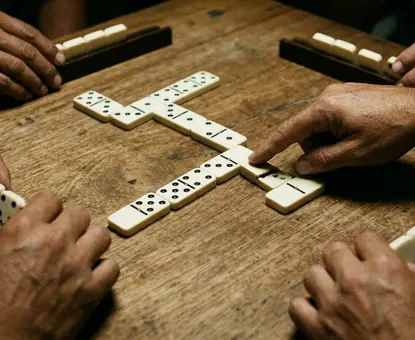
Use this constructed position: the exposed ends are Four and One. Your hand contains 2-4, 2-2, and 3-4; the opponent also holds three tiles. The board contains this continuous chain, with each adjacent pair representing a tile:
4–0–0–1–1–2–0–3–1–5–0–6–2–5–3–6–4–5–5–6–1.
Reading the chain checks both continuity and inventory. The accounted-for Four-bearing tiles are 0-4, 4-5, and 4-6 on the board, plus 2-4 and 3-4 in your hand. The visible Six-bearing tiles are 0-6, 1-6, 2-6, 3-6, 4-6, and 5-6.
Assign the Five Unresolved Tiles
After removing the board and your hand from the complete set, the unresolved tiles are 1-4, 2-3, 3-3, 4-4, and 6-6. They occupy the opponent's three-tile hand and the sleeping pair.
The opponent previously passed with Two and Three exposed. That excludes 2-3 and 3-3 from their hand. Both must therefore be sleeping. The opponent holds exactly 1-4, 4-4, and 6-6.
Depletion narrowed the search. The pass assigned ownership. Keeping those operations separate makes the reconstruction auditable.
Preserve Two While Spending Their Fours
- Play 2-4 on the Four end. The ends become Two and One. Of the opponent's reconstructed tiles, only 1-4 fits. Their compulsory reply leaves Two and Four exposed.
- Play 2-2. The exposed numbers remain Two and Four. The opponent must now spend 4-4, again leaving Two and Four.
- Finish with 3-4. Your hand empties. The opponent retains 6-6, worth 12 pips.
The line occupies three of your turns and two opponent replies. Every reply follows from the reconstructed hand, so the run-out is forced.
The retained 2-2 supplies the squeeze's timing. It lets you preserve the Two end while requiring the opponent to spend 4-4. Spend that double too early and the proposed continuation loses its waiting move. The stranded 6-6 illustrates how a heavy double can become irrelevant to legal play while remaining expensive in the hand.
Before Playing 2-4
- Confirm the exposed ends are Four and One.
- Check your hand: 2-4, 2-2, and 3-4.
- Reconcile 20 exposed tiles, six held tiles, and two sleepers.
- Verify the earlier compulsory pass on Two and Three.
- Assign both sleeping tiles before calculating the forced replies.
This position rewards exact reconstruction with a run-out. A proposed lock would need its own terminal position and pip comparison; here, the winning continuation ends when 3-4 leaves your hand.
Make Two-Player Block Your Deduction Exercise
Compulsory follow-suit rules in trick-taking games create exclusions comparable to a domino pass. Suit counting begins with 13 cards per suit in a standard deck, while the operative question remains familiar: which holdings survive the player's legal obligation?
Mahjong offers another inventory comparison. In a standard four-copy structure, four visible copies exhaust a tile identity. Discards and exposed melds distribute the evidence differently from a domino chain, but the accounting habit is recognizable. Update the pool, distinguish absence from preference, and test a continuation against every legal reply.
Across chess, traditional tiles, and number-line games, that precise transfer holds: isolate the deductive operation being trained and examine it directly.
Review the Pass That Changed the Calculation
After each practice hand, reconstruct the decisive pass. Identify the later move that depended on it, then review the final three turns. Ask whether the continuation followed from recorded tiles and exclusions, or whether an opponent happened to cooperate.
The two sleeping tiles simplify reconstruction compared with a larger sleeping pool, while deal luck remains part of the exercise.
Set multiplayer Draw aside during dedicated analytical practice and commit to the 13-tile, two-player Block exercise with a double-six set; review the final three turns before dealing again.