
The March 1, 1849 Registration Benchmark and Initial Condition Record
On March 1, 1849, Nathaniel Cooke registered the ornamental design for the Staunton chess pattern under the Ornamental Designs Act of 1842, followed by the pattern's commercial introduction in September 1849. Museum collection histories, including those of the Victoria and Albert Museum, provide an established starting point for checking this chronology. However, the March 1, 1849 design registration dates the Staunton pattern; it does not authenticate a specific king's broken cross, its underside stamp, or its claimed London workshop origin. Establishing the exact lineage of a damaged historical chess set requires separating legal design benchmarks from the physical evidence on the workbench.
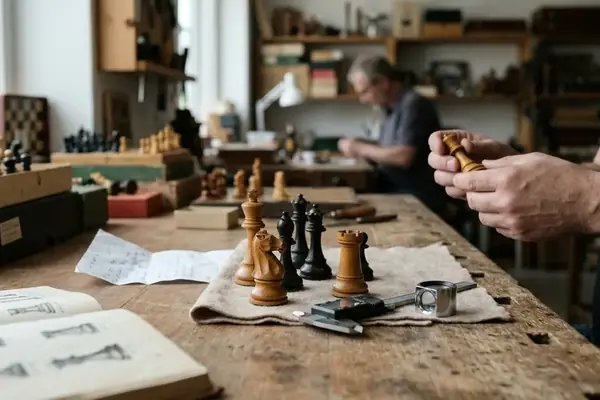
Because no intake photographs, provenance documents, treatment logs, or test results accompany our initial brief, we must treat this examination as a proposed conservation protocol rather than an authenticated workshop outcome. Consider a classic specimen presented for evaluation: a weighted boxwood and dark-wood tournament ensemble recovered from prolonged damp cellar storage. The proposed intake record presents severe structural and cosmetic challenges across the 32 pieces. Several dark bases exhibit pronounced radial shrinkage cracks, internal lead weights have detached from their cavities, the white king's cross-finial is snapped at the collar, and the light timber bears a heavy yellow-brown surface coating alongside dense, wax-like accretions.
Visual inspection alone cannot confirm whether those yellow-brown deposits represent aged nicotine contamination or degraded varnish, nor can it identify the composition of the wax-like buildup without material analysis. Before touching a single piece with a swab or chisel, a comprehensive baseline intake record must be created for all 32 chessmen. Each piece requires precise documentation of its height, maximum base diameter, total mass, loose components, visible fractures, and surviving identifying marks.
Every damaged piece must be photographed from the side and directly underneath against a calibrated scale. Documenting the undersides and deep collar recesses prior to any surface cleaning is critical. Those protected zones frequently retain original lathe turning marks, historic adhesive residues, textile impressions, and faint maker's marks that aggressive re-turning or chemical stripping would permanently erase. Proceeding with invasive restoration before establishing this forensic baseline severs the tangible link between the physical object and its manufacturing history.
Forensic Authentication of Hatton Garden Turnery Before Touching a Tool
True authentication of a nineteenth-century Jaques of London chess set relies on mutually supporting lines of evidence: documented provenance, surviving packaging, engraved or stamped inscriptions, dimensional proportions, and specific carving geometry. Attributing an undocumented set demands strict verification before committing to conservation hours. If stylistic resemblance does not align with physical markings, the attribution remains unresolved.
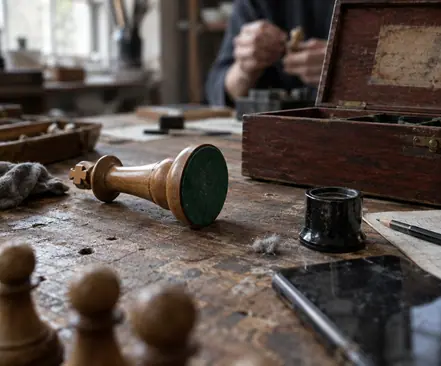
A common misconception among novices involves searching the undersides of the kings and queens for degraded remnants of red-and-black printed paper labels bearing Howard Staunton's facsimile signature. A signed paper label beneath each sovereign piece is not a dependable authentication expectation; prominent signed labels bearing the "John Jaques & Son, London" imprint and facsimile signature are historically associated with the original mahogany or Carton Pierre storage boxes rather than the bases of the playing pieces themselves. Instead, forensic examination of the chessmen focuses on inspecting the foot rims of both kings for impressed maker's stamps, while thoroughly examining the accompanying storage box, its underside, and its interior lining for surviving printed labels. All marks must be photographed in raking light before disturbing degraded base cloth or attempting to open threaded joints.
The carving geometry of the knights and the turning profiles of the crowns offer primary material evidence. Our protocol records each knight's muzzle profile, nostril cutting, mane striation, ear angle, and undercut jawline in consistent frontal and lateral photographs. Comparing these specific artisan details against securely dated museum examples and documented collector specimens helps situate the turnery within a distinct production period.
Similarly, inspecting the summits of the rooks and knights for the traditional King's side markers requires precision. In genuine early sets, traditional crown marks identify the king's rook and king's knight to prevent castling confusion during play, rather than marking a queen's knight. When documenting these stamped impressions, record the mark's exact position and surface appearance without assuming that any surviving red pigment is original sealing wax. Where two-part pieces feature threaded construction, measure the accessible joint's diameter and thread pitch only if the components separate without mechanical force. Thread pitch alone cannot establish hand manufacture or distinguish nineteenth-century Hatton Garden turnery from twentieth-century workshop production, just as an early design registration date cannot prove a particular set was turned at the original London premises without object-specific dating evidence.
Weighing Patina Preservation Against Structural Stabilization
Once the physical baseline and attribution boundaries are recorded, the conservator faces a single strategic decision regarding intervention. We evaluate three distinct operational paths against the set's active deterioration, handling requirements, and surface integrity:
- Archival Storage (Zero Intervention): Preserves the extant historical object inside a climate-buffered enclosure with minimal handling. This route prevents tool-induced wear on original surfaces, though loose internal weights and unstable fractures remain vulnerable to catastrophic loss if the pieces are ever moved or set upright on a board.
- Structural Conservation (Sympathetic Stabilization): Addresses unstable joints, detached weights, and vulnerable breaks using retreatable methods while retaining aged surface patinas and tool marks. This approach is favored whenever loose lead slugs or fractured collars threaten secondary mechanical damage during routine cataloging.
- Cosmetic Reconstruction (Full Restoration): Alters the visual appearance of the set through invasive lathe re-turning, chemical bleaching, sanding, and French polishing. While yielding a uniform modern appearance, it obliterates original surface history and artisan tool chatter.
Selecting structural conservation requires understanding the mechanics of differential wood movement inside weighted bases. Dense dark hardwoods—whose exact botanical or Ceylon origin cannot be assigned from dark color or assumed age alone, respond to ambient humidity fluctuations in a direction-dependent manner, shrinking radially and tangentially at different rates. When a timber base houses a rigid metal weight within a restricted cavity alongside aged adhesive and accumulating corrosion products, those elements interact with the wood's natural moisture response. However, a radial ebony-base split, a loose lead slug, and white corrosion are three separately recorded conditions, not proof of one lead-expansion failure.
Attempting to force a distorted, radially split base shut with modern cyanoacrylate (superglue) introduces severe conservation hazards. While a secondary fracture elsewhere on the collar is never mathematically guaranteed, clamping a shrunken base tight around an unyielding core introduces concentrated mechanical stress, while thin cyanoacrylate causes irreversible capillary penetration into porous end-grain, dark staining, and extreme difficulty during future retreatment.
When weighing these trade-offs, drawing on auction house condition reports, we observe that the financial consequences of structural repairs fluctuate across the collector market. While retained carving crispness and undisturbed surface history carry substantial weight with institutional buyers, neither an automatic loss of collector value nor a universal market preference for visible timber splices is established across all sales venues, and identifying aged coatings or uncertain hazardous deposits may require specialist conservation analysis before finalizing a treatment valuation.
Decontaminating the Boxwood and Extracting Oxidized Lead Weights
Surface decontamination begins with controlled dry mechanical cleaning to lift loose particulate matter without altering the underlying timber. Retaining high-resolution photographs of the untreated surfaces, we use a soft brush and localized collection to clear dust from deep turning coves and knight manes. Where degraded lead weights are exposed, dry brushing or vacuuming suspected lead corrosion into an ordinary domestic vacuum must be strictly avoided to prevent dispersing toxic particulates.
Addressing the dense yellow-brown surface material and wax-like accretions on the boxwood requires localized testing. Even deionized water is not inherently harmless to aged organic finishes or oxidized timber surfaces. Before touching a prominent piece, we test a barely dampened cotton swab carrying deionized water and a measured non-ionic surfactant on an inconspicuous underside recess. The treatment log must record the exact cleaning solution, surfactant concentration, test location, contact method, and observed surface response before extending aqueous cleaning across the bodies of the pieces. The objective is lifting surface soot and grime while leaving the warm, oxidized honey-amber surface layer intact.
Beneath the bases, degraded green billiard-cloth baize often conceals the weighting cavity. Where loose or tattered cloth must be lifted to access structural splits, representative original fragments are carefully detached, documented, and retained in archival enclosures alongside the storage box as material evidence of the set's historic presentation.
Lead Corrosion Containment Protocol
Exposed white crusting on historical chess weights requires strict hazardous-material containment. While white powdery corrosion on lead frequently includes lead carbonates, visual inspection alone cannot identify the chemical compound conclusively. Consult established museum references, such as the Canadian Conservation Institute's guidance on recognizing active metal corrosion, alongside the Victoria and Albert Museum conservation guidelines for historic wood, to distinguish empirical corrosion observations from unsupported chemical assumptions. Always wear appropriate nitrile gloves, work within a dedicated containment tray completely separated from food preparation areas, wash hands thoroughly after handling, and collect all contaminated debris for compliant hazardous waste disposal. Never subject corroded lead weights to dry sanding, wire-brushing, or thermal heating.
When addressing the weights themselves, chemical "neutralization" of lead corrosion directly inside an ebony base is not an established conservation step for releasing wood stress. Instead, each piece must be evaluated individually to determine whether the internal weight is already detached, mechanically retained by an undercut wooden lip, or bonded with old pitch or animal glue. Under no circumstances should a tool be pried against cracked ebony to lever out a stubborn core; if a weight remains partially bound within a fractured base, a specialist must determine a safe extraction method that avoids propagating the split through the upper turning collar.
Executing Reversible Micro-Joinery on the Split Bases and King's Finial
Every surviving wooden fragment must be dry-fitted without adhesive to evaluate alignment and structural contact before selecting a bonding agent or introducing replacement timber. In ethical antique conservation, the core requirement is retreatability and minimal damage to original material, rather than blind allegiance to one mandatory adhesive. Hot hide glue is frequently favored for accessible, close-fitting timber joints because it softens under controlled heat and moisture. However, an assembled hide-glue joint in a fragile, thin-walled chess piece is not automatically reversible without risk to surrounding wood fibers, aged surface finishes, or adjacent components. When hide glue is selected, the workshop log must record the specific hide-glue product, gram strength, water-to-glue preparation ratio, working temperature, and treatment date.
Fabricating a replacement cross-finial for the white king demands strict empirical discipline:
- Establish the Reference Geometry: Derive the exact height, arm thickness, and chamfer angles of the missing cross from a securely comparable king of matching scale and period, rather than guessing the proportions.
- Select and Document Salvage Timber: Source aged boxwood with tight grain and compatible oxidation tone so the repair integrates visually without chemical staining. Note that claiming salvage timber is nineteenth-century requires specific provenance; record the replacement wood's exact source and distinguish the new component clearly in the treatment diagram and post-treatment photographs.
- Mate the Fracture Interface: Shape the base of the new finial to match the existing break profile on the king's crown. Utilize an existing central socket if one survives and proves structurally sound. If a microscopic bamboo or boxwood dowel pin is required for shear resistance, recognize that inserting a dowel introduces foreign material and usually requires a prepared hole; document any newly drilled material removal explicitly in the log rather than describing the pinning operation as non-invasive.
Stabilizing the radial splits in the dark bases follows a similarly restrained methodology. The base's unstressed geometry must dictate the repair. Using padded, controlled restraint—such as surgical silicone tension bands over protective barrier strips, we perform a dry trial fit to observe how far the crack closes naturally without forcing the timber. Where wood shrinkage or historic splinter loss leaves a persistent wedge-shaped gap, forcing the walls shut will distort the turning profile and load the joint with tension. Instead, we machine a tapered sliver of aged, color-matched ebony to bridge the void, bonding the insert in place with hide glue so the base retains its relaxed circumference.
Before re-seating any extracted lead weight, the interior cavity wall and the metal slug must be isolated. Applying a barrier around a retained lead weight requires specifying the exact conservation coating material in the treatment record and verifying its physical fit and chemical compatibility inside the cavity; merely calling an unnamed coating inert is insufficient. Finally, when applying new base baize to protect the stabilized undersides, specify the replacement cloth in the documentation by fiber content, weave structure, thickness, and color, describing it as historically matched only when surviving original fragments or a documented comparable set directly supports that specification.
Post-Conservation Audit and the Non-Negotiable Rule for Antique Sets
A rigorous conservation workflow concludes by repeating the complete intake protocol after treatment and comparing every stabilized piece against its pre-treatment baseline. All 32 chessmen and every retained original fragment—including detached baize samples and displaced corrosion crusts, must be accounted for in the final inventory. Because our examination establishes a methodological framework rather than reporting a completed physical intervention, no fabricated final masses, plumb alignment readings, or post-treatment measurements are stated here; in an active studio audit, exact before-and-after figures are logged side by side.
Each piece is tested for standing stability on a verified flat reference surface. The post-conservation audit records mechanical rocking, visible axial lean, and any residual internal weight movement as separate empirical observations. Tactile balance during board play is noted as a qualitative handling assessment rather than a numerical metric. To verify that surface cleaning and structural clamping preserved the set's manufacturing evidence, the conservator repeats the underside and collar photographs using the identical lighting angles, focal lengths, and reference scale established during intake. Comparing these matched views confirms whether original Hatton Garden lathe chatter marks and impressed foot-rim stamps remain completely legible beneath the newly laid baize.
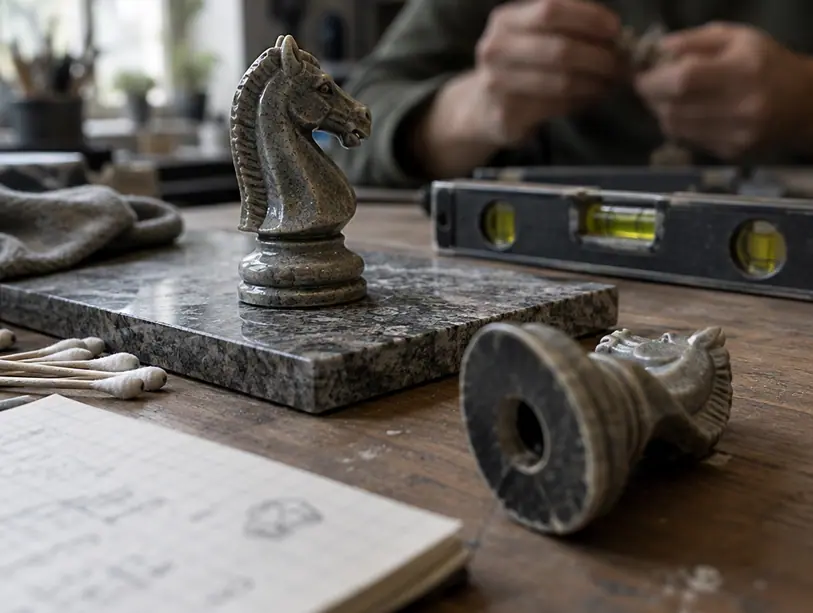
Transparency for future collectors, curators, and auction catalogers depends on a permanent two-part documentation archive:
- The Master Conservation Dossier: Retained separately in the owner's permanent records, this comprehensive file identifies each treated piece, the original structural defect, exact treatment dates, specific adhesive formulations and fill materials, provenance of replacement timber parts, hazardous lead-handling protocols, cataloged retained samples, and full-scale pre- and post-treatment photographs.
- The Storage Box Summary: A concise physical treatment ledger placed directly inside the chess box alongside the pieces. This summary must be printed on a loose archival paper sheet or housed inside an inert polyester sleeve; never paste or attach a new conservation label over an original manufacturer's label or directly onto historic wood surfaces.
When stewarding an antique chess set of this caliber, the boundary between preservation and destruction is absolute. If a collector, dealer, or restorer cannot execute a structural repair supported by a sound, fully documented conservation plan that preserves original tool marks and relies on retreatable joinery, they must leave the break completely untouched, protect the damaged piece from handling, and preserve all detached fragments safely inside the box.